


Bitcoin is testing $83,000 as Treasury yields hit 2007 highs, while falling open interest and exchange reserves shape the next BTC move.

Share
Bitcoin has slipped toward $83,100 as rising U.S. Treasury yields pressured risk assets and pushed BTC toward the lower edge of its recent trading range.
Summary
- Bitcoin traded near $83,100 while rising Treasury yields pressured risk appetite before major U.S. data.
- Ten-year Treasury yields reached 5.27%, their highest since 2007, as investors reassessed rate expectations globally.
- Binance Bitcoin reserves fell roughly 23,000 BTC between September 21 and September 28, CryptoQuant reported.
- Analysts see $83,000 as nearby support while liquidation clusters remain concentrated around $85,300 above price.
- Open interest declined for over a week as leveraged longs and short positions continued shrinking.
Bitcoin was down less than 1% during Tuesday’s Asian session after the 10-year Treasury yield climbed to its highest level since 2007. The benchmark yield reached roughly 5.27% on Monday as oil prices, inflation concerns and expectations for further Federal Reserve tightening weighed on markets.
Bitcoin had traded closer to $84,000 before the latest pullback, following last week’s run toward $87,000. Zcash fell around 12% to $1,380 during the same session, while Solana and Hyperliquid lost between 3% and 4%. Dogecoin declined 3%, BNB fell 2% and XRP lost nearly 2%.
The total cryptocurrency market capitalization stood near $2.86 trillion as traders prepared for another set of U.S. economic releases.
You might also like:
Bitcoin price tests $83K support as 4-hour Supertrend turns bearish
Why is Bitcoin price falling today?
Higher U.S. bond yields have returned as one of the main macro pressures on BTC. The 10-year Treasury yield reached levels last seen in 2007, while the 30-year yield moved near highs not recorded since the early 2000s.
The Federal Reserve raised its target range by 25 basis points on Sept. 16 to 3.75%–4.00%, citing elevated inflation and resilient economic activity.
Market attention now turns to the August personal consumption expenditures report. The Bureau of Economic Analysis scheduled the release for Sept. 30 at 8:30 a.m. ET. July headline PCE inflation stood at 3.7% year over year, while core PCE increased 3.3%.
Higher yields have previously weighed on BTC by increasing the return available on government debt while tightening financial conditions. In related coverage, BTC tested $83,000 as its four-hour MACD turned bearish after Treasury yields climbed and the rally from below $76,000 began losing momentum.
BTC still remains well above its mid-August levels near 63,000–65,000. The daily structure has continued to form higher highs and higher lows, though the rejection near 86,000–87,000 has moved BTC back into consolidation.
Can Bitcoin price hold the $83,000 support?
On the daily chart, BTC is trading around the 83,000–84,000 region after failing to sustain its latest push toward $87,000.
The RSI stands near 62.14, above the neutral 50 level and below the 70 overbought threshold. Its reading remains slightly below the RSI moving average near 63.32, showing that momentum has eased from the recent advance.
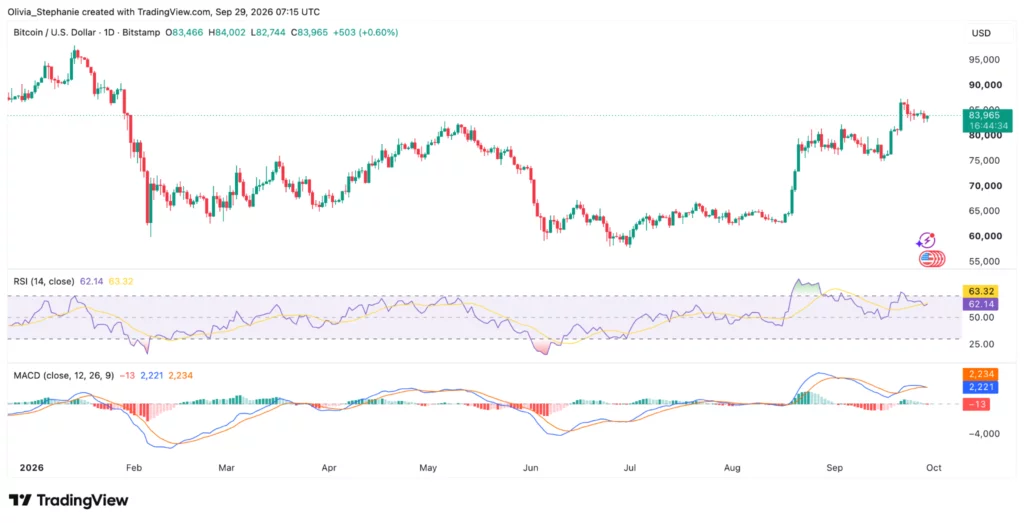
MACD presents a similar picture. The MACD line is near 2,221 compared with a signal line around 2,234, while the histogram sits slightly negative near -13. Both lines remain well above zero, but the small bearish crossover shows that short-term upward momentum has weakened.
Previous crypto.news analysis identified the $83,600 region as an important Bitcoin support area after its $87,000 rejection. The current price is testing the same general zone.
Rekt Capital said BTC had completed a weekly close above the upper boundary of its former 60,000–80,000 macro range. The analyst described the current move back toward that breakout area as a “trend-defining” retest.
Under that analysis, maintaining the breakout would preserve the higher-range structure. A sustained move back below the former range boundary would return BTC toward the consolidation area that contained price before the recent rally.
Could falling open interest help Bitcoin recover?
Derivatives positioning shows leverage leaving the market as Bitcoin trades sideways.
One market analysis noted that BTC futures open interest has declined for more than a week. The contraction reportedly includes liquidations of highly leveraged long positions alongside a reduction in outstanding shorts.
Shrinking short exposure does not guarantee a price recovery, but the analyst argued that fewer bearish positions reduce one source of continued selling pressure.
CrypNuevo said BTC had already swept stop-loss orders below local support and could be attempting another move toward $85,000. The analyst identified a new liquidation concentration around $85,300.
$BTC before and after of both Price Action and Liquidations analyses since the Sunday update:
So far, it’s going well. They took the stop-losses below the local support and we could be seeing the start of the new push to +$85k.
We can see more liquidations at $85.3k now 👀 pic.twitter.com/Jy3OK17hqs
— CrypNuevo 🔨 (@CrypNuevo) September 29, 2026
That region overlaps with resistance identified in recent market data. As crypto.news previously reported,Bitcoin faced concentrated sell orders between $85,000 and $85,800 after retreating from its weekly high.
A recovery through $85,300–$85,800 would put the recent $87,000 area back into focus. Failure to reclaim the mid-$85,000 range would leave $82,000–$83,000 as the nearest visible support zone on the daily chart.
Binance reserves fall as USDT liquidity stays high
Exchange reserve data provides another piece of the current BTC setup.
CryptoQuant analyst Amr Taha reported that Binance’s Bitcoin reserves fell from approximately 701,000 BTC on Sept. 21 to 678,000 BTC on Sept. 28.
The decline amounts to roughly 23,000 BTC, or 3.3%, within one week. Ethereum reserves moved in the same direction, falling from around 3.65 million ETH on Sept. 19 to approximately 3.54 million ETH by Sept. 28.
Taha calculated the Ethereum decline at roughly 110,000 ETH, or 3%. Binance’s USDT reserve did not contract at the same pace and remained near $38.1 billion.
The analyst said the next point to watch is whether the stablecoin balance remains unused or begins flowing into spot crypto purchases. Falling exchange balances by themselves do not establish whether holders intend to sell, hold or move assets between platforms and private wallets.
Earlier Binance data showed a different monthly pattern. In August, Binance users increased their Bitcoin holdings by more than 16,000 BTC while Ethereum and USDT user balances declined.
For the immediate Bitcoin price setup, traders face the Sept. 30 PCE release with BTC testing $83,000 support, liquidation liquidity near $85,300 and Treasury yields remaining close to multi-decade highs.
Disclosure: This article does not represent investment advice. The content and materials featured on this page are for educational purposes only.
Read more:
MoonPay targets won stablecoins as it expands into South Korea
More Posts About This Newsroom
crypto.news
-
 Riot Platforms closes $200M Coinbase Bitcoin credit line
-
 Political memecoins blur public power and private profit: GSN CEO
-
 Crypto ETFs draw $2.39 billion as Bitcoin retreats on Treasury yield surge
-
 Bittensor adoption grows as AI subnets find paying customers, Yuma CRO says
-
 Tokenized RWA usage should be judged asset by asset, says Falcon exec