

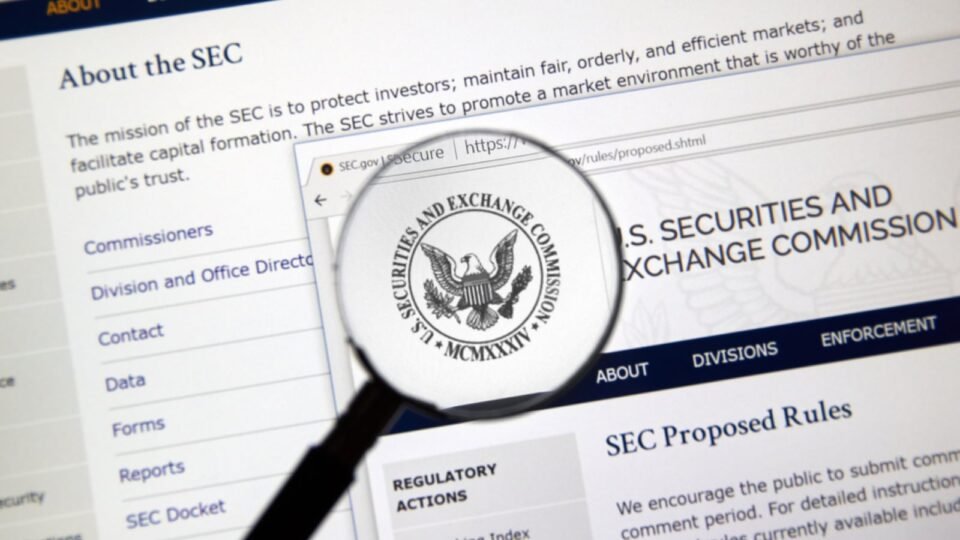
The U.S. Securities and Exchange Commission has proposed a sweeping new crypto custody framework that could make it easier for registered investment advisers and regulated funds…
The U.S. Securities and Exchange Commission has proposed a new regulatory framework for crypto.
The aforementioned framework would make it easier for registered investment advisers and regulated funds to get exposure to the novel asset class on behalf of clients, including, in some cases, through self-custody.
The proposal would amend custody requirements under the Investment Advisers Act of 1940 and the Investment Company Act of 1940.
The SEC would permit advisers to self-custody certain crypto assets when an appropriate outside custodian is unavailable. State-chartered trust companies would also receive a pathway to be crypto custodians.
SEC Chairman Paul Atkins has stated that existing custody rules were built around a financial system that looked very different from today’s.
Bitcoin did not exist when much of the framework was developed. Since then, crypto has become a multi-trillion-dollar asset class sought by investors.
Atkins said the proposal is intended to replace the regulatory uncertainty surrounding crypto custody with a defined compliance framework for investment advisers and funds. In his words, the existing rules had been “crafted for a bygone era.”
It is worth noting that these are only proposed rules. Their final form could change following public feedback.
The proposal does not simply give investment advisers unrestricted permission to hold private keys themselves.
An adviser would first have to determine that a permitted custodian is unavailable for the particular crypto asset. This would have to be done before the adviser takes custody and then repeated at least once every quarter.
Self-custody would function as a conditional alternative. The adviser would also need to show that it has the necessary expertise to safeguard the specific crypto asset.
Custodians would have to address private-key management and joint authorization by at least two people. Advisers would also have to maintain each client’s crypto in one or more blockchain addresses containing only that client’s assets.
They would also have to take into account the risks associated with keeping client crypto directly.
An adviser would need to prepare a report that would examine controls connected to custodial services, including necessary safeguards.
Clients would receive account statements at least quarterly. Those statements would identify the blockchain address holding the client’s crypto and the network on which the address operates.
For now, the proposal remains just a proposal. The public will have 60 days to submit comments in the Federal Register.
More Posts About This Newsroom
u.today
-
 Hyperliquid (HYPE), Stellar (XLM), Zcash (ZEC) and Ethereum (ETH) Price Analysis for October 2: Investors Take Profits
-
 XRP Sentiment Crashes to Lowest Level Since August
-
 Crypto-Powered WordPress Malware Refuses to Die
-
 Dogecoin Gains More US Ground: Fully Regulated Perps Now Live
-
 XRP Holders, Mark Your Calendars for October 8: Nasdaq Listing Is Coming for Ripple-Backed Treasury